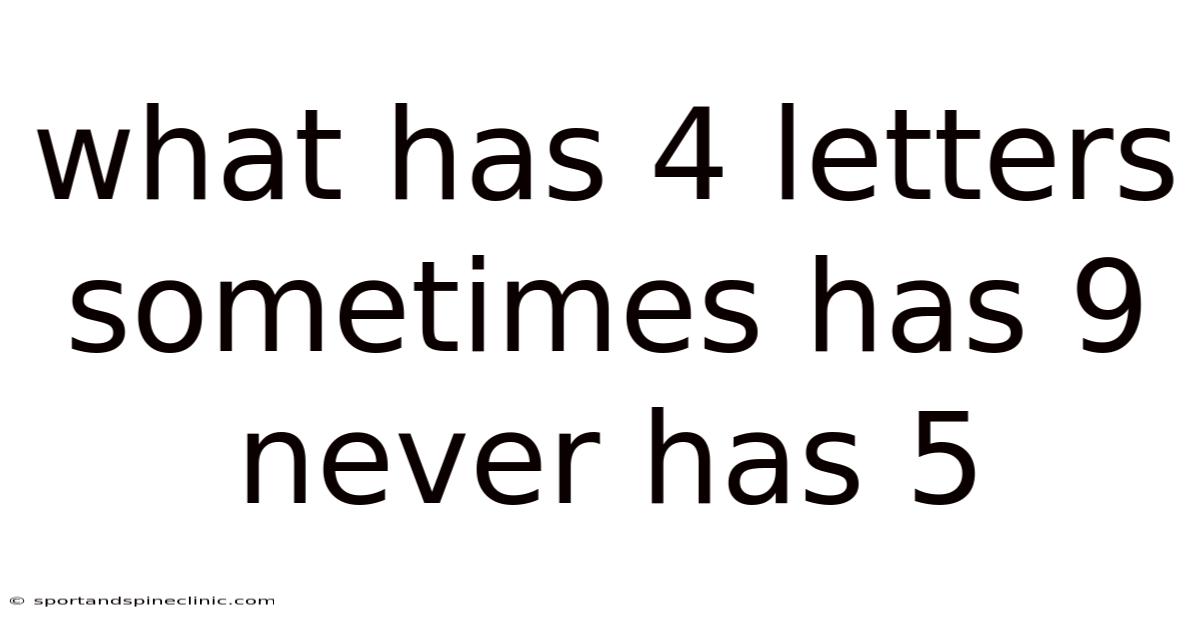
What Has 4 Letters, Sometimes Has 9, Never Has 5?
A classic riddle that turns a simple sentence into a brain‑teaser, this puzzle challenges readers to think beyond the surface and spot the hidden trick. In this article we’ll unpack the riddle, explore why it works, and show how it can be used as a fun teaching tool for logic, language, and critical thinking.
Introduction
Riddles have been part of human culture for millennia, serving as entertainment, puzzles, and even educational tools. Plus, the riddle “What has 4 letters, sometimes has 9, never has 5? They push us to question assumptions, look for patterns, and consider alternative meanings. ” is a perfect example: it sounds like a question about a mysterious object, but the answer lies in the very wording of the sentence itself.
Main keyword: riddle explanation
Semantic keywords: wordplay, logic puzzle, language trick, teaching tool
How the Riddle Works
1. The Surface Reading
At first glance, the sentence appears to describe a single entity that changes its number of letters over time:
- What has 4 letters
- Sometimes has 9 letters
- Never has 5 letters
Most people interpret this as a riddle asking for a word or concept that fits these conditions. The natural instinct is to look for a word that can be 4, 9, and 5 letters long simultaneously—a paradoxical requirement that seems impossible.
2. The Hidden Twist
The key lies in treating the sentence as a set of statements about words, not as a question about a single object. Each clause is a factual claim about a specific word:
| Clause | Word | Letter Count |
|---|---|---|
| “What has 4 letters” | what | 4 |
| “Sometimes has 9 letters” | sometimes | 9 |
| “Never has 5 letters” | never | 5 |
Every time you read the riddle this way, it stops being a paradox and becomes a simple observation about English spelling. The trick is that the riddle is self‑referential—it talks about the words that make up the riddle itself And it works..
Step‑by‑Step Breakdown
-
Identify the subject of each clause.
- In “What has 4 letters,” the subject is the word what.
- In “Sometimes has 9 letters,” the subject is sometimes.
- In “Never has 5 letters,” the subject is never.
-
Count the letters in each subject word.
- what → 4
- sometimes → 9
- never → 5
-
Confirm the counts match the numbers given.
The numbers in the sentence match the actual letter counts, proving the riddle’s logic. -
Realize the riddle’s purpose.
It’s designed to mislead by presenting the structure of a typical “What is…” question, while the answer is merely a statement about the words themselves And it works..
Why This Riddle Is Effective
| Feature | Explanation |
|---|---|
| Simplicity | The riddle uses everyday words and basic counting, making it accessible to all ages. In practice, |
| Educational Value | It highlights the importance of context and interpretation in language comprehension. Still, |
| Cognitive Twist | It forces the solver to shift from a conventional “find a thing” mindset to a meta‑analysis of the sentence structure. |
| Memorability | The unexpected answer ("the words themselves") makes it a memorable brain teaser that can be shared easily. |
Using the Riddle in Teaching
1. Developing Critical Thinking
- Activity: Present the riddle to students and ask them to write down their initial guesses. Then guide them through the step‑by‑step analysis.
- Learning Outcome: Students practice questioning assumptions and exploring alternative interpretations.
2. Enhancing Language Skills
- Vocabulary Expansion: Discuss synonyms for what, sometimes, and never and how changing the word changes the letter count.
- Spelling Awareness: Highlight how English spelling can be non‑intuitive (e.g., sometimes vs. sometimes).
3. Introducing Logic and Pattern Recognition
- Pattern Matching: Create a worksheet where students match words to their letter counts.
- Logical Deduction: Ask students to devise their own riddles that use a similar self‑referential trick.
Common Misconceptions
| Misconception | Clarification |
|---|---|
| **It’s a trick question about a hidden object.Because of that, ** | The riddle is about the words what, sometimes, and never, not an object. But |
| **The numbers refer to something else (e. Here's the thing — g. Plus, , days, letters in the alphabet). On the flip side, ** | The numbers are literal letter counts of the specific words mentioned. So |
| The answer is “the riddle. ” | While the riddle itself is involved, the precise answer is the observation that each word’s letter count matches the number stated. |
It sounds simple, but the gap is usually here Worth keeping that in mind..
Variations of the Riddle
Educators can adapt the core idea to create new puzzles:
| Original | Variation |
|---|---|
| What has 4 letters, sometimes has 9, never has 5? | Why has 3 letters, often has 7, never has 4? |
| What has 4 letters, sometimes has 9, never has 5? | **When has 5 letters, always has 8, never has 6? |
In each variation, the solver must again identify the subject words and count their letters. This keeps the challenge fresh while reinforcing the underlying logic Small thing, real impact..
Frequently Asked Questions
Q1: Is this riddle suitable for young children?
A: Yes. The language is simple, and the activity can be turned into a counting exercise. Adjust the difficulty by choosing shorter or longer words Worth keeping that in mind. Worth knowing..
Q2: Can this riddle be used in a classroom setting?
A: Absolutely. It’s an excellent ice‑breaker, a quick mental warm‑up, or a way to transition between lessons on language and logic.
Q3: How can I create my own self‑referential riddle?
A: Choose a set of words you like, count their letters, and craft a sentence that states those counts. The key is to make the sentence read like a conventional question or statement so that the solver is led astray.
Q4: Why does the riddle use the word “never” instead of “always”?
A: The word never is chosen because it has five letters, which neatly matches the number in the sentence. Always would have six letters, requiring a different number.
Conclusion
The riddle “What has 4 letters, sometimes has 9, never has 5?” is more than a playful trick; it’s a lesson in reading between the lines, questioning assumptions, and appreciating the quirks of language. By dissecting its structure, educators can transform a simple puzzle into a multifaceted teaching moment that strengthens critical thinking, language skills, and logical reasoning. Whether used in a classroom, a family game night, or a casual conversation, this riddle invites everyone to pause, think, and discover that sometimes the answer lies right in front of us—within the very words we read.
The riddle "What has 4 letters, sometimes has 9, never has 5?In practice, " is a perfect example of how language can be both playful and profound. So at first glance, it seems to be a straightforward question, but upon closer inspection, it reveals a clever twist: the answer lies not in an object or concept, but in the words themselves. The word "what" has 4 letters, "sometimes" has 9 letters, and "never" has 5 letters. This self-referential nature makes the riddle a delightful exercise in critical thinking and attention to detail Surprisingly effective..
Honestly, this part trips people up more than it should Simple, but easy to overlook..
Educators can use this riddle as a tool to teach students about the importance of careful reading and logical reasoning. By presenting a puzzle that challenges assumptions, it encourages learners to question their initial interpretations and look deeper into the structure of language. This kind of thinking is invaluable in both academic and real-world contexts, where problems often require a shift in perspective to solve That's the part that actually makes a difference. And it works..
Worth adding, the riddle can be adapted into variations to keep the challenge fresh and engaging. To give you an idea, "Why has 3 letters, often has 7, never has 4?" or "When has 5 letters, always has 8, never has 6?" These adaptations maintain the core concept while introducing new words and letter counts, making them suitable for different age groups and skill levels Not complicated — just consistent. Nothing fancy..
In a classroom setting, this riddle can serve as an excellent icebreaker or a quick mental warm-up. It’s simple enough for young children to grasp, yet intriguing enough to captivate older students and adults. By turning the riddle into a counting exercise or a discussion about language, teachers can create a dynamic and interactive learning experience.
In the long run, the riddle "What has 4 letters, sometimes has 9, never has 5?" is more than just a clever trick—it’s a reminder of the beauty and complexity of language. It invites us to pause, think, and appreciate the nuances of words and their meanings. Whether used in education, casual conversation, or as a fun puzzle, it continues to inspire curiosity and critical thinking in all who encounter it It's one of those things that adds up. No workaround needed..
